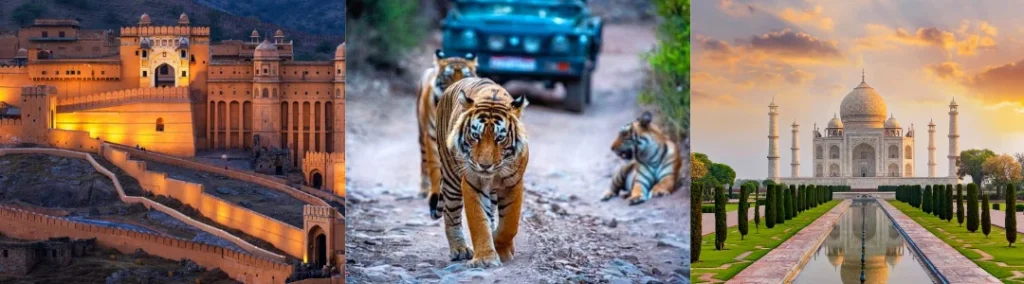

Picture this: you’re standing in front of the Taj Mahal as the morning light turns the marble from soft pink to glowing white. Later that week you’re riding a houseboat through the quiet backwaters of Kerala, and the week after you’re sharing a home-cooked thali with a family in Rajasthan. The surprise for many Americans is that this kind of trip often costs less than a week in Hawaii or a long weekend in Paris.
India is one of the best-value long-haul destinations in the world, and for travelers from the USA, 2026 and the 2026-27 travel season are a very good time to go. But value only comes from smart planning. This guide covers what a trip actually costs, what’s included in a package, which itineraries suit first-timers, how to handle the visa and flights, and how to avoid overpaying. If you’d rather have an expert build it for you, Tripstro designs India trips for international travelers.
Why India Should Be on Your 2026 Travel List
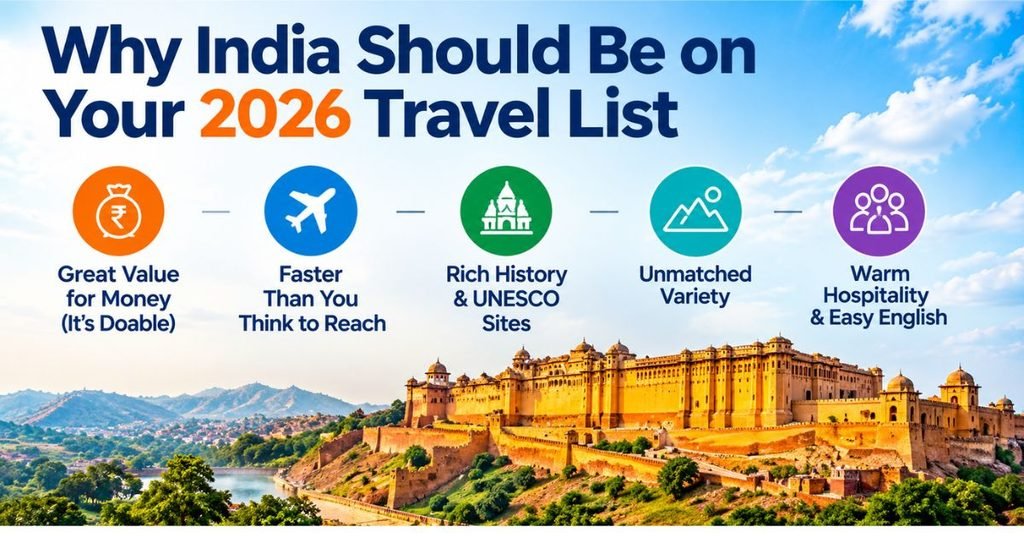
1. Your US Dollar Goes a Long Way
Comfortable hotels, private air-conditioned cars with drivers, expert local guides, and restaurant meals all cost far less in India than in the US or Western Europe. A day that would cost several hundred dollars at home can cover a well-rounded, guided experience in India, hotel included.
2. Getting There Is Easier Than You Think
India is a major destination for American travelers, and flight options from the US have grown over the years. Nonstop and one-stop routes operate from gateways such as New York/Newark, Chicago, San Francisco, Washington DC, and other major hubs, with many additional connections via Europe and the Gulf. Schedules change, so always check current airline timetables. For US citizens, the entry process is largely online through India’s e-Visa system.
3. A Living History Spanning Thousands of Years
India’s civilization stretches back more than 4,500 years to the Indus Valley, and the country is home to over 40 UNESCO World Heritage Sites. A few highlights Americans love:
- The Taj Mahal (Agra): Commissioned by Mughal Emperor Shah Jahan in memory of his wife Mumtaz Mahal, and built over roughly two decades beginning around 1631.
- Amber Fort (Jaipur): Part of the UNESCO-listed Hill Forts of Rajasthan, with mirrored halls and elephant-era ramparts.
- Jaipur’s Pink City: Inscribed by UNESCO in 2019 as a rare example of a planned historic city.
- Varanasi: Among the world’s oldest continuously inhabited cities, famous for its evening Ganga Aarti ceremony.
- Hampi, Khajuraho, Ajanta and Ellora: Ancient temples and rock-cut caves that rival any archaeological site in the world.
4. Variety No Other Country Can Match
In one trip you can see desert forts, Himalayan foothills, palm-fringed beaches, tea plantations, tiger reserves, and megacities. India works for couples, families, solo travelers, photographers, foodies, and wellness seekers alike.
5. Warm Hospitality and Easy English
English is widely spoken in tourism, and guides, drivers, and hotel staff on organized tours communicate comfortably with American visitors. That makes the trip far smoother than many first-time travelers expect.
India Tour Package Price: What Should You Really Expect to Pay?
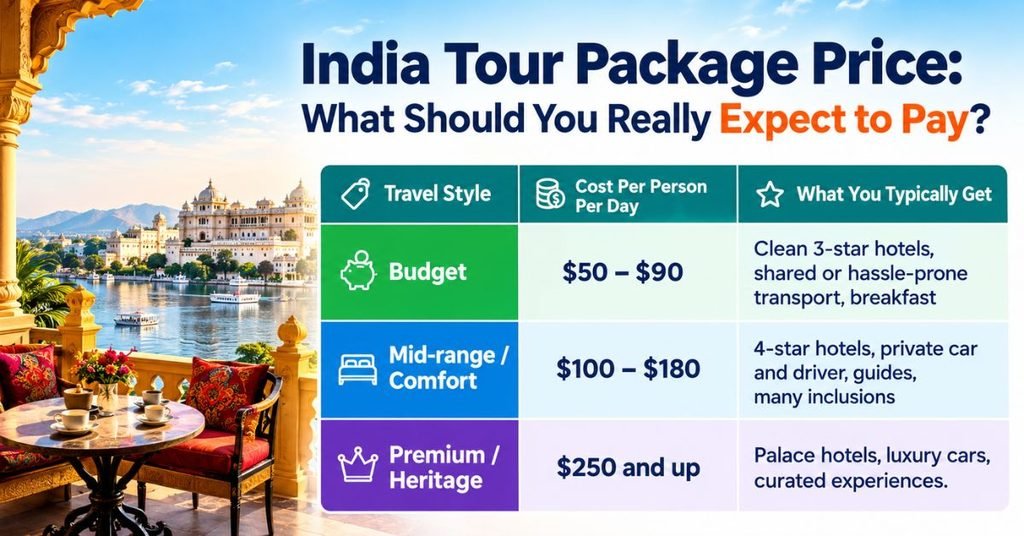
The most common question from US travelers is simple: how much will it cost? The honest answer is that it depends on season, hotel level, trip length, group size, and what’s included.
The ranges below are indicative market estimates to help you budget. Actual prices vary by operator, date, and demand, so treat them as a starting point and request a live quote before booking.
Estimated Daily Budget (Per Person, Twin-Sharing, Land Arrangements)
| Travel Style | Approx. Cost Per Person Per Day | What You Typically Get |
|---|---|---|
| Budget | $50–$90 | Clean 3-star hotels, shared or basic private transport, breakfast |
| Mid-range / Comfort | $100–$180 | 4-star hotels, private car and driver, guides, many inclusions |
| Premium / Heritage | $250 and up | Palace hotels, luxury cars, curated experiences |
For most American travelers, mid-range is the sweet spot. You get comfortable hotels, private transport, and expert guides without paying a luxury premium.
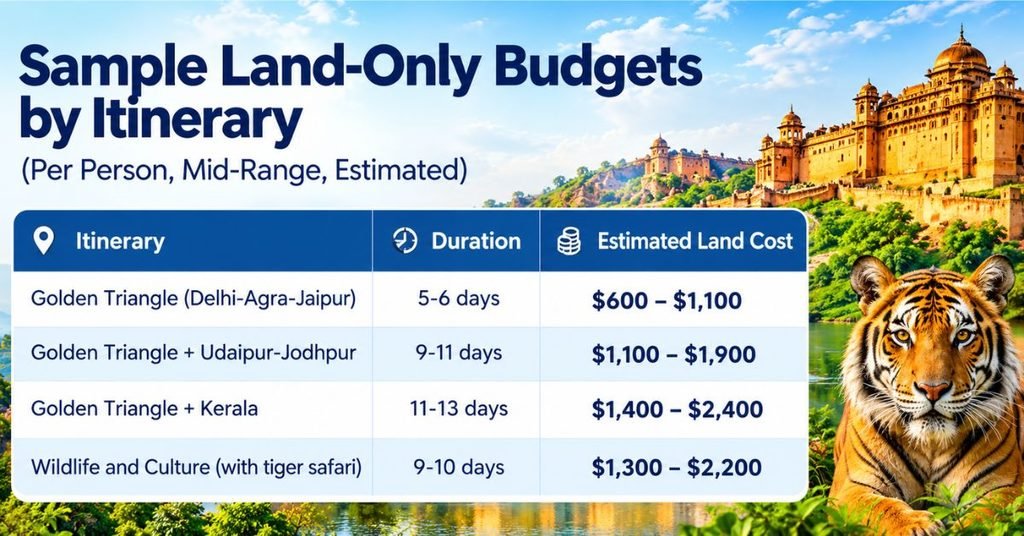
Sample Land-Only Budgets by Itinerary (Per Person, Mid-Range, Estimated)
| Itinerary | Duration | Estimated Land Cost |
|---|---|---|
| Golden Triangle (Delhi-Agra-Jaipur) | 5-6 days | $600-$1,100 |
| Golden Triangle + Udaipur/Jodhpur | 9-11 days | $1,100-$1,900 |
| Golden Triangle + Kerala | 11-13 days | $1,400-$2,400 |
| Wildlife and Culture (with tiger safari) | 9-10 days | $1,300-$2,200 |
Don’t Forget the Flights
International airfare is usually the biggest single cost after the trip itself. Economy round-trip fares from the US to Delhi or Mumbai commonly range from roughly $900 to $1,800 depending on departure city, season, and how early you book. Fares move constantly, so use these as rough planning numbers and check current prices.
What Moves the Price Up or Down
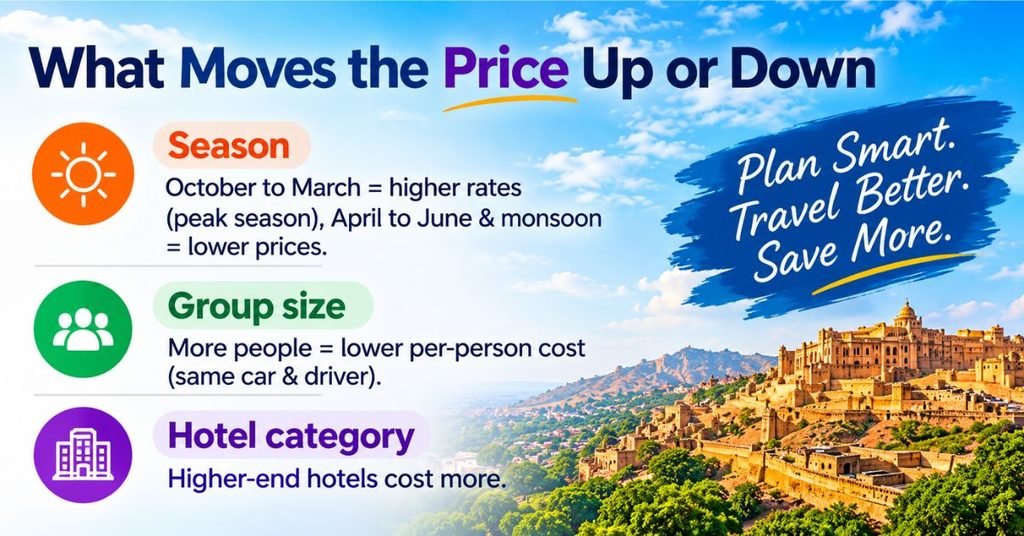
- Season: October to March is peak season with the best weather and highest rates. April to June and the monsoon months often bring lower hotel prices.
- Group size: A private car and driver cost the same for one traveler or four, so per-person cost drops as the group grows.
- Hotel category: A heritage palace can cost several times more than a comfortable 4-star hotel.
- Inclusions: Monument tickets, guides, meals, and transfers can add up fast if booked separately.
- Festivals: Dates around Diwali (early November in 2026), Holi (early March), and Christmas/New Year raise demand and prices in popular cities.
Want a number that fits your dates and group? Request a personalized India tour package price from Tripstro.
All Inclusive India Tour Packages: What’s Actually Included?
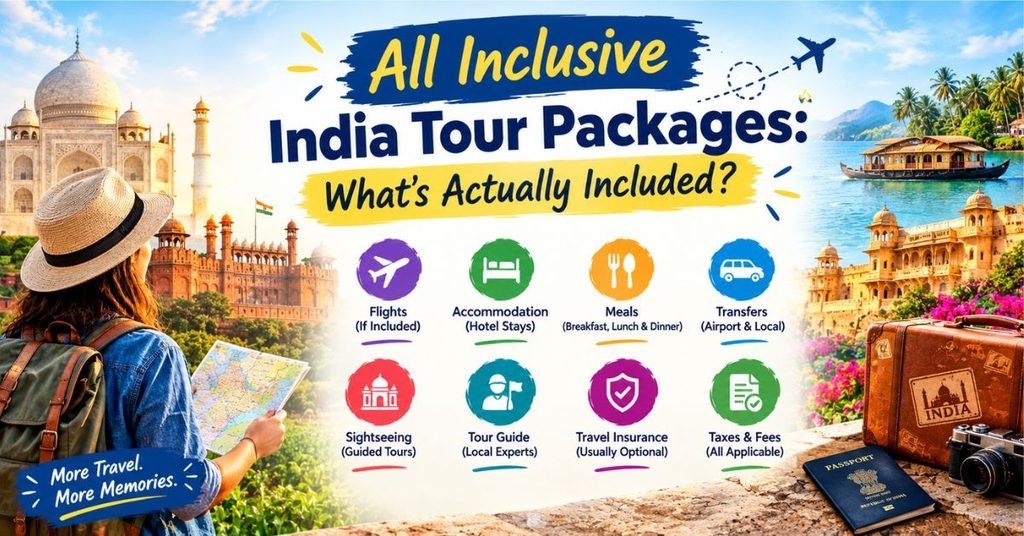
The phrase “all inclusive” means different things at different companies. In India, it typically refers to a bundle that covers your major ground costs, so you aren’t haggling or budgeting every day. A strong all inclusive India tour package usually includes:
- Accommodation for every night of the trip
- Daily breakfast, and often selected lunches or dinners
- A private air-conditioned vehicle with an English-speaking driver
- Licensed local guides at major monuments
- Entrance fees to included sights
- Airport and station transfers
- Domestic train or flight segments (on some itineraries)
- 24/7 on-trip support
Typically Not Included (Always Confirm)
- International flights (unless you choose a flight-inclusive package)
- Visa fees
- Travel insurance
- Tips for guides and drivers
- Personal shopping and optional activities
All Inclusive India Tour Packages with Flight: Are They Worth It?
For travelers who want one point of contact for everything, all inclusive India tour packages with flight can simplify things. Bundling international airfare with your ground itinerary can mean:
- One booking instead of several
- Better coordination between arrival time and your first hotel and transfer
- Easier changes if your plans shift, since one provider handles it all
Before you commit, ask:
- Are international flights included, or only domestic flights within India?
- Which US departure cities are supported?
- What’s the baggage allowance, and can you choose seats?
- What happens if the airline reschedules?
Sometimes booking flights separately lets you use airline miles or catch a sale fare. A good planner will explain both options honestly. Ask Tripstro about flight-inclusive planning from your US city.
USA to India Tour Packages: 5 Popular Itineraries for American Travelers
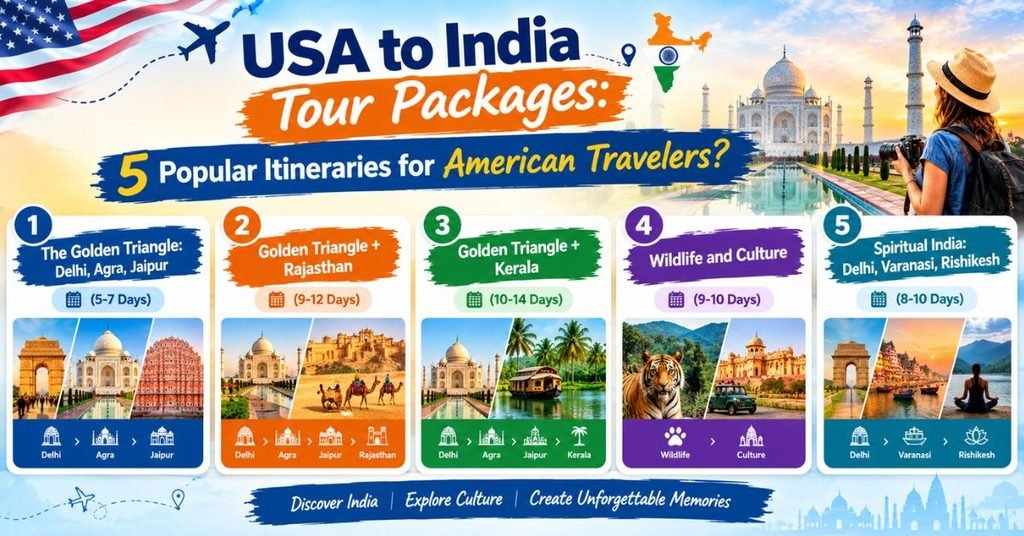
1. The Golden Triangle: Delhi, Agra, Jaipur (5-7 Days)
Best for: First-timers, short trips, tight budgets
This is the most popular first trip for a reason. It links three iconic cities by well-developed roads.
- Delhi: Explore Old Delhi’s Red Fort and Jama Masjid, then New Delhi’s India Gate, Humayun’s Tomb, and Lodhi Garden. Try street-food tours with a guide for a safe, delicious introduction.
- Agra: See the Taj Mahal at sunrise and visit Agra Fort. Note that the Taj Mahal is closed on Fridays, so plan around it.
- Jaipur: Visit Amber Fort, the City Palace, Hawa Mahal, and the Jantar Mantar observatory. Jaipur is also known for block-printed textiles, jewelry, and blue pottery.
It’s the most affordable way to see India’s headline attractions, and it’s easy to extend later.
2. Golden Triangle + Rajasthan (9-12 Days)
Best for: Couples, photographers, history lovers
Add Jodhpur, the blue-washed city under the Mehrangarh Fort, and Udaipur, the lakeside “City of Lakes” with its City Palace and romantic sunsets. You may also visit Pushkar or Jaisalmer if time allows. This route delivers India’s most cinematic scenery.
3. Golden Triangle + Kerala (10-14 Days)
Best for: Travelers who want culture and relaxation
Fly south after Jaipur to Kochi, then explore Alleppey’s backwaters by houseboat and Munnar’s rolling tea estates. Add an Ayurvedic massage or a cooking class. The combination of northern grandeur and southern calm makes it one of the most balanced itineraries.
4. Wildlife and Culture (9-10 Days)
Best for: Nature lovers and families with older kids
Pair Delhi, Agra, and Jaipur with a safari at Ranthambore National Park, one of the best-known places in India to look for wild Bengal tigers. Sightings are never guaranteed, but the park’s scenery and ruined fort make the visit memorable regardless.
5. Spiritual India: Delhi, Varanasi, Rishikesh (8-10 Days)
Best for: Wellness seekers and culture-focused travelers
Experience the Ganga Aarti ceremony at Varanasi, then head to Rishikesh, known as the “Yoga Capital of the World,” for yoga, meditation, and riverside walks.
All of these can be customized. Tell Tripstro your dates and interests, and they’ll help shape the right route.
Family Holiday Packages in India: Is India Good for Kids?
Absolutely, with the right setup. Many American families find India to be one of the most memorable trips they’ve taken together. The key is choosing family holiday packages in India that are built around comfort and pacing.
What to Look For
- Private transport: Your own vehicle means flexibility for bathroom breaks, naps, and snack stops.
- Short driving days: Aim for 3-4 hours maximum between cities with kids.
- Hotels with pools and family rooms: Pools are a lifesaver after a morning of sightseeing.
- Interactive experiences: Cooking classes, puppet shows, camel rides, kite flying in Jaipur, and houseboat stays in Kerala keep children engaged.
- Ethical wildlife experiences: Choose sanctuaries and safaris with responsible practices.
- Food flexibility: Most hotels and many restaurants serve mild, familiar dishes alongside Indian cuisine.
Traveling with Grandparents?
Multi-generational trips work well when you slow the pace, limit one-night stays, and use private transport. Ask for hotels with elevators and minimal stairs, and consider a mid-day rest built into each schedule.
Family Travel Tips
- Bring hand sanitizer, wet wipes, and any children’s medications.
- Keep passports, visas, and itineraries in a single travel folder.
- Pack light, breathable clothing and sun protection.
Tripstro can customize a family itinerary around your children’s ages, interests, and your comfort level.
Best Time to Visit India from the USA
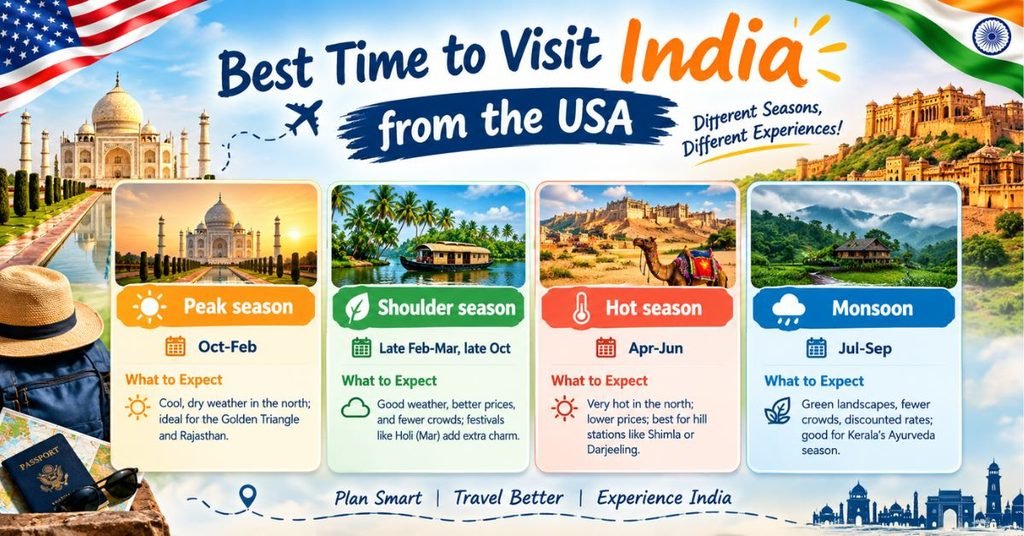
India’s weather varies widely by region, so the best time depends on where you’re going.
| Season | Months | What to Expect |
|---|---|---|
| Peak season | Oct-Feb | Cool, dry weather in the north; ideal for the Golden Triangle and Rajasthan. Book early. |
| Shoulder season | Late Feb-Mar, late Oct | Good weather, better prices, and festivals such as Holi |
| Hot season | Apr-Jun | Very hot in the north; lower prices; best for hill stations like Shimla or Darjeeling |
| Monsoon | Jul-Sep | Green landscapes, fewer crowds, discounted rates; good for Kerala’s Ayurveda season |
Money-saving tip: The shoulder months, particularly early-to-mid March and late October into November, often balance weather and price best.
Planning from the US: Because India’s peak season coincides with the holidays, travelers who want December or January dates should book several months ahead for the best hotels and flight options.
What US Travelers Need to Know Before Booking
Visa Requirements
US citizens generally need a visa to enter India. A tourist e-Visa can be applied for online, and options and fees have varied over time, with shorter-stay and longer-validity choices available. Always check the official Indian government e-Visa portal for current fees, processing times, and eligibility before applying. Apply well in advance, and make sure your passport has enough validity and blank pages.
Flights and Jet Lag
Nonstop flights from the US typically take around 14-16 hours, and connecting itineraries take longer. India is roughly 9.5 to 10.5 hours ahead of US Eastern Time, depending on daylight saving time. To handle jet lag:
- Plan a light first day with no major sightseeing
- Get sunlight in the morning
- Stay hydrated and limit alcohol on the plane
Health and Safety
- Speak with your doctor or a travel clinic 4-6 weeks before departure about recommended vaccines and medications. The CDC’s travelers’ health pages list current guidance for India.
- Drink bottled or filtered water, and avoid ice in unfamiliar places.
- Pack basic medications, including stomach remedies.
- Travel insurance with medical coverage and evacuation is strongly recommended.
- Check the US State Department’s travel advisory for India before you go, and consider enrolling in the Smart Traveler Enrollment Program (STEP).
- Booking with a reputable operator that uses vetted drivers, guides, and hotels is one of the most effective ways to travel with confidence.
Money, Cards, and Tipping
India’s currency is the rupee. Credit cards are widely accepted in hotels and larger restaurants, but cash is useful for markets, small shops, and tips. Let your bank know you’re traveling, and consider a card without foreign transaction fees. Tipping drivers and guides is customary and appreciated.
Cultural Etiquette
- Dress modestly at temples and mosques, with shoulders and knees covered.
- Remove shoes before entering religious sites.
- Use your right hand when eating or giving items.
- Bargaining is normal in markets; do it with a smile.
Staying Connected
Many US carriers offer international plans, and local SIM or eSIM options are an easy way to get data. Hotels typically provide Wi-Fi.
Indian Food: A Highlight for American Travelers
Food alone can justify the trip. India’s cuisine varies dramatically by region:
- North India: Butter chicken, dal makhani, naan, kebabs, and paneer dishes
- Rajasthan: Dal baati churma, laal maas, and rich sweets
- South India: Dosas, idlis, coconut-based curries, and fresh seafood
- Street food: Chaat, samosas, and pani puri, best sampled on guided food walks
Vegetarian, vegan, and gluten-aware travelers generally find India very accommodating, since vegetarian cooking is central to the cuisine. Tell your tour planner about dietary needs in advance.
8 Smart Ways to Get the Most Affordable India Tour Package
- Book early. Better hotel availability and often better rates.
- Travel in shoulder season. Fewer crowds and lower prices without giving up good weather.
- Choose mid-range hotels. Comfort at a fraction of luxury pricing.
- Pick a focused route. Fewer cities mean less transport cost and a more relaxed trip.
- Compare inclusions, not just headline prices. Check guides, entrance fees, transfers, and meals.
- Travel with a small group or family. Private vehicle costs get shared.
- Watch your flights. Compare flight-inclusive packages with booking separately, and be flexible with dates.
- Work with an expert. A tailored plan avoids paying for things you won’t use.
Common Mistakes First-Time Visitors Make
- Trying to see too much. India is big. Slow down and enjoy fewer places.
- Skipping travel insurance. It’s small money for big peace of mind.
- Booking the cheapest possible deal. Extremely low prices often hide extra costs or compromised quality.
- Ignoring seasonality. Visiting the north in peak summer can be exhausting.
- Overpacking. Laundry is easy and affordable in India.
- Not building buffer time. Traffic and delays happen, so avoid tight connections.
Why Book Your India Trip with Tripstro?
Choosing the right planner is as important as choosing the right itinerary. Tripstro helps international travelers plan India journeys with:
- Customized itineraries built around your budget, dates, and interests
- Transparent inclusions, so you know exactly what’s covered
- Private, comfortable transportation with experienced drivers
- Options for families, couples, solo travelers, and small groups
- Flexible trip lengths, from short Golden Triangle getaways to multi-region journeys
- Responsive support before and during your trip
Ready to Plan Your India Trip?
Get a free, no-obligation quote for your India tour package at Tripstro.com →
Frequently Asked Questions
How much does an India tour package cost for US travelers?
It depends on trip length, hotel category, season, and inclusions. Mid-range land packages often fall in a per-person, per-day range, with flights usually extra unless you choose a flight-inclusive option. For an accurate India tour package price, request a customized quote.
What are the most affordable USA to India tour packages?
The Golden Triangle (Delhi, Agra, Jaipur) is typically the most budget-friendly way to see India’s highlights. Traveling in shoulder season and choosing mid-range hotels helps keep costs down.
Are all inclusive India tour packages worth it?
For most first-time visitors, yes. They reduce planning stress and make your budget more predictable. Always check exactly what’s included.
Can I book all inclusive India tour packages with flight from the USA?
Yes, some operators offer flight-inclusive packages. Ask about your departure city, baggage, and flexibility. Tripstro can advise on flight-inclusive planning.
Is India safe for American tourists?
Millions of international visitors travel to India each year. Use standard precautions, check the US State Department advisory, and travel with a reputable operator.
How many days do I need in India?
Five to seven days covers the Golden Triangle. Ten to fourteen days lets you add Rajasthan or Kerala.
Are family holiday packages in India suitable for young children?
Yes, if the itinerary is paced well, with private transport, short driving days, and family-friendly hotels.
Do I need a visa?
US citizens generally do. Check the official e-Visa portal for current requirements.
Do I need to speak Hindi?
No. English is widely spoken in tourism, and guides and drivers on organized tours speak English.
Should I tip in India?
Tipping guides, drivers, and hotel staff is customary. Your tour planner can suggest typical amounts.
Final Thoughts: Make 2026 the Year You See India
India isn’t a destination you simply visit; it’s one you remember. The colors, the flavors, the history, and the generosity of the people stay with travelers long after they fly home. With smart planning, a mid-range budget, and the right local partner, a trip to India can be both affordable and extraordinary.
Whether you’re planning a first-time Golden Triangle adventure, a Rajasthan honeymoon, or a multigenerational family holiday, the best first step is a conversation with someone who knows the country.