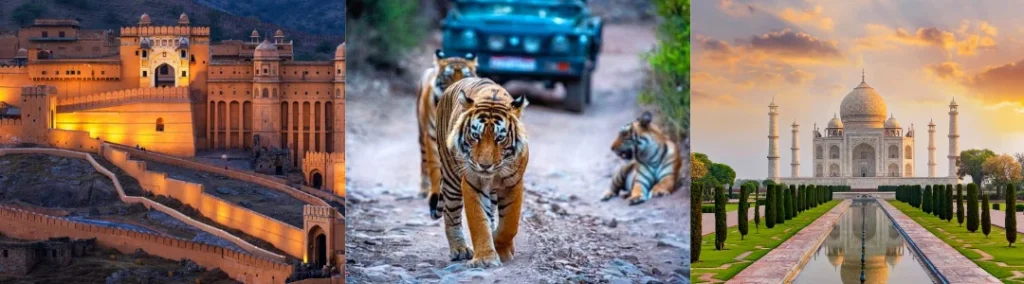

Compare Taj Mahal and Jaipur tourism and you are weighing two very different journeys. Agra gives you one flawless marble monument. Jaipur gives you a living Pink City of forts, palaces and bazaars. This guide compares both on tickets, timings, crowds, costs and seasons, using verified 2026 information. Whether you have one day or one week, this Taj Mahal and Jaipur tourism comparison will help you choose, or combine them.
Last fact-checked: 12 October 2026. Prices and timings can change, so confirm them with the official sources linked below before you book.
Quick Answer: Taj Mahal or Jaipur?
- Choose the Taj Mahal for one iconic, UNESCO-listed monument in about half a day.
- Choose Jaipur for variety: forts, palaces, markets and food over 2 to 3 days.
- Choose both if you have 4 or more days. Agra and Jaipur are roughly 240 km apart, about 4 to 5 hours by road.
Taj Mahal vs Jaipur at a Glance
| Feature | Taj Mahal (Agra) | Jaipur (Pink City) |
|---|---|---|
| Experience | One monument and its gardens | A whole city of attractions |
| Time needed | 3–4 hours | 2–3 days |
| UNESCO status | Taj Mahal (1983) | Jantar Mantar (2010), Hill Forts of Rajasthan incl. Amber (2013), Jaipur City (2019) |
| Built by | Shah Jahan, for Mumtaz Mahal | Maharaja Sawai Jai Singh II (founded 1727) |
| Mood | Romantic, serene, symmetrical | Royal, colourful, lively |
| Weekly closure | Every Friday | Most monuments open daily |
| Best for | Photography, history, couples | Culture, shopping, food, families |
What Is Taj Mahal Tourism Like?
The Taj Mahal is India’s most recognised monument. A visit is focused and often crowded. You queue, pass through the great gate and see the white marble mausoleum framed by gardens and reflecting pools.
Most travellers need only half a day. That makes Agra easy to add to a longer India itinerary.
A Short History
Mughal emperor Shah Jahan commissioned the Taj Mahal after his wife Mumtaz Mahal died in 1631. Construction ran from about 1632 to 1653. It is built of white marble inlaid with semi-precious stones, and the main mausoleum rises to roughly 73 metres.
UNESCO inscribed it in 1983. See the official UNESCO listing for the Taj Mahal.
What You Will See
- The Great Gate: your first framed view of the dome
- The main mausoleum: cenotaphs and carved marble screens
- The charbagh gardens: a Persian-style four-part layout
- The mosque and its twin building: red sandstone flanking the tomb
- Mehtab Bagh: a garden across the Yamuna with sunset views of the Taj
Taj Mahal Ticket Prices (2026)
Prices depend on nationality. Entering the main mausoleum costs an extra ₹200.
| Visitor category | Entry fee | Mausoleum add-on | Total |
|---|---|---|---|
| Indian / OCI | ₹50 | ₹200 | ₹250 |
| SAARC / BIMSTEC | ₹540 | ₹200 | ₹740 |
| Foreign tourists | ₹1,100 | ₹200 | ₹1,300 |
Children under 15 enter free. Tickets are valid for about 3 hours. Online booking through the official ASI ticket portal is the safest option and may carry a small discount. Foreign visitors should carry a passport.
Timings and Friday Closure
The Taj Mahal opens about 30 minutes before sunrise and closes about 30 minutes before sunset. It is closed every Friday to general visitors because the mosque in the complex is used for Friday prayers.
Night viewing is limited to a few nights around the full moon. It needs advance booking and is not offered on Fridays or during Ramadan. Check the Archaeological Survey of India for current notices.
What Is Jaipur Tourism Like?
Jaipur is the capital of Rajasthan and a key stop on the Golden Triangle with Delhi and Agra. Its tourism is spread across many places. You can visit a hill fort in the morning, a palace at noon and a bazaar at night.
The old walled city is painted terracotta pink, a tradition dating to 1876 when it was decorated to welcome the Prince of Wales.
A Short History
Maharaja Sawai Jai Singh II founded Jaipur in 1727. It was one of India’s first planned cities, laid out on a grid with the help of architect Vidyadhar Bhattacharya. The walled city joined the UNESCO World Heritage List in 2019. See the UNESCO listing for Jaipur City.
Top Attractions in Jaipur
- Amber (Amer) Fort: a hilltop Rajput fort begun in 1592, known for the mirrored Sheesh Mahal
- City Palace: a palace complex with museums and courtyards, still partly used by the royal family
- Hawa Mahal: the “Palace of Winds”, built in 1799 with 953 small windows
- Jantar Mantar: an 18th-century observatory with a giant stone sundial about 27 metres tall
- Nahargarh Fort: a ridge-top fort with sunset views of the city
- Jal Mahal: a lake palace best viewed from the shore
- Albert Hall Museum: a museum in Indo-Saracenic style
Amber Fort and Jantar Mantar are UNESCO-listed. See Hill Forts of Rajasthan and Jantar Mantar.
Food, Shopping and Culture
Jaipur is as much a market city as a monument city. Visitors come for block-printed textiles, silver jewellery, blue pottery and Rajasthani dishes such as dal baati churma. The Jaipur Literature Festival, held each January, adds a cultural draw.
This variety is the main difference in any Taj Mahal and Jaipur tourism comparison. The Taj is a single, powerful moment. Jaipur is a place you spend time in.
Jaipur Ticket Prices (Verify Before You Go)
Jaipur fees are less consistent online than Taj Mahal fees. Rajasthan monument fees were reported as revised around January 2026, and older figures still circulate. The table shows ranges reported across recent sources, so treat it as a planning guide only.
| Attraction | Indian adult (approx.) | Foreign adult (approx.) |
|---|---|---|
| Amber Fort | ₹100–₹200 | ₹500–₹1,000 |
| City Palace | ₹130–₹300 | ₹500–₹1,000 |
| Hawa Mahal | ₹50–₹100 | ₹200–₹600 |
| Jantar Mantar | ₹50–₹100 | ₹200–₹600 |
A two-day composite ticket covers several government-run monuments, such as Amber Fort, Hawa Mahal, Jantar Mantar and Nahargarh Fort. Reported prices range from about ₹300 to ₹600 for Indians and ₹1,000 to ₹1,700 for foreigners. City Palace is privately managed and may be ticketed separately.
Confirm exact fees at the counter or through Rajasthan Tourism.
Cost Comparison: Which Is Cheaper?
For a short visit, the Taj Mahal is simpler and cheaper. One ticket covers the whole experience.
For a longer stay, Jaipur costs more in entry fees because you visit many sites. A composite ticket reduces this if you plan three or more included monuments. Food, local transport and accommodation are generally affordable in both cities.
Crowds and Timings
Crowds at the Taj Mahal are concentrated in one place. They peak at sunrise, on weekends and during winter holidays. Jaipur crowds spread across many sites, with the busiest points at Amber Fort and Hawa Mahal around midday.
Most Jaipur monuments open between 8:00 and 9:30 AM and close between 4:30 and 6:30 PM. Hours vary by site, so check each one.
The best strategy for both cities is to arrive at opening time.
Best Time to Visit
Both destinations share the same seasons, and October to March is the best window.
- October to March: pleasant weather and the best sightseeing. In December and January, morning fog in Agra can hide the Taj.
- April to June: very hot, often above 40°C in both cities.
- July to September: monsoon with humidity, fewer tourists and greener hills around Jaipur.
For the clearest Taj views, many travellers prefer October, November, February or March.
How to Get There
- Delhi to Agra: about 230 km by road via the Yamuna Expressway, roughly 3.5 hours. Fast trains such as the Gatimaan Express take around 1 hour 40 minutes.
- Delhi to Jaipur: about 280 km by road, roughly 5 hours, with frequent trains and flights.
- Agra to Jaipur: about 240 km, 4 to 5 hours, passing Fatehpur Sikri, another UNESCO site.
For official planning information, visit Incredible India.
Who Should Choose Which?
Choose the Taj Mahal if you:
- Have only one day near Delhi
- Want an iconic photo and a focused visit
- Love Mughal history and architecture
Choose Jaipur if you:
- Have two or more days
- Enjoy shopping, food and culture
- Prefer variety over a single sight
Choose both if you:
- Have 4 to 6 days and want the classic Golden Triangle
Sample 4-Day Itinerary
- Day 1: Delhi to Agra. Visit Agra Fort, then Mehtab Bagh at sunset.
- Day 2: Taj Mahal at opening time, then drive to Jaipur via Fatehpur Sikri.
- Day 3: Amber Fort early, then City Palace, Jantar Mantar and Hawa Mahal.
- Day 4: Jaipur bazaars and cafés, then onward travel.
Avoid planning the Taj for a Friday.
Practical Tips
- Book Taj tickets online to skip counter queues.
- Carry photo ID, and a passport if you are a foreign visitor.
- Pack light. Large bags, food, tripods and drones are restricted at the Taj, and rules are enforced at security.
- Expect photography restrictions inside the mausoleum chamber.
- Wear comfortable shoes you can remove easily at the main tomb.
- Use licensed guides booked through official counters.
- Start early to avoid heat and crowds.
Frequently Asked Questions
Which is better for tourism, Taj Mahal or Jaipur?
Neither is universally better. The Taj Mahal suits a short, iconic visit. Jaipur suits a multi-day trip with forts, palaces, food and shopping.
How many days do I need?
Allow half a day for the Taj Mahal and 2 to 3 days for Jaipur. A combined trip works well in 4 to 5 days.
How far is Jaipur from the Taj Mahal?
About 240 km, roughly 4 to 5 hours by road.
Is the Taj Mahal closed on Fridays?
Yes, it is closed to general visitors every Friday.
How much is the Taj Mahal ticket for foreigners in 2026?
₹1,100 for entry plus ₹200 for the main mausoleum, a total of ₹1,300.
When is the best time to visit both?
October to March, when the weather is cooler.
Final Verdict
If you want one unforgettable monument, choose the Taj Mahal. If you want a full cultural experience, choose Jaipur. With four days or more, do both and enjoy the contrast between Mughal elegance and Rajput grandeur.
When you compare Taj Mahal and Jaipur tourism by depth and variety, Jaipur wins. By sheer impact in a short time, the Taj wins.
How This Guide Was Fact-Checked
- Taj Mahal fees, timings and the Friday closure were cross-checked across multiple current 2026 sources and match the structure published by the ASI.
- Historical facts and heritage dates follow UNESCO World Heritage listings.
- Jaipur ticket prices are shown as ranges because sources disagree after the reported 2026 revision. We have not stated a single figure we could not confirm.
Official sources: UNESCO World Heritage Centre, Archaeological Survey of India, Incredible India, Rajasthan Tourism, Britannica: Taj Mahal.
You may also like : Best Travel Agency For The Golden Triangle Tour, Same Day Tour to Agra from Jaipur